

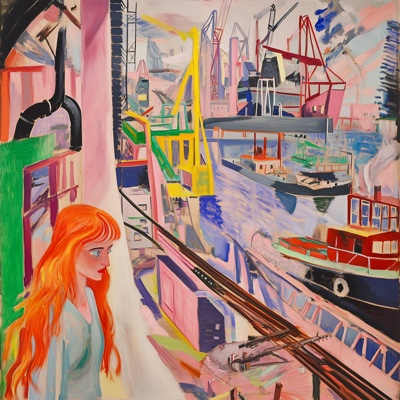
Europe must not become an industrial museum
The idea was European. The company became American. Production became Chinese. All that remained in Europe was a conference on competitiveness. Now Europe must build again.
The idea was European – the company became American
Imagine a young Swedish engineer. She has the knowledge. She has the training. She has an idea that could change how we produce energy, build vehicles or automate industry.
But the battery is made in China. The software is bought from the United States. Venture capital heads across the Atlantic. The permit gets stuck between authorities. The grid connection is delayed. And when production is finally due to begin, it turns out that the suppliers, toolmakers and component manufacturers are already somewhere else.
The idea was European. The company became American. Production became Chinese. All that remained in Europe was a conference on competitiveness.
This is the reality we must dare to face. Europe is not yet an industrial museum. But that is where we are heading.
We risk becoming a continent proud of what we once built, while others build what comes next. A continent where old factory names glow above empty workshops. Where the head office remains, while development moves away. Where the brand is European, the software American, the battery Chinese and the future somebody else’s.
Yesterday’s successes must not become tomorrow’s alibi
Naturally, there will be those who say this is exaggerated. They will point to our outstanding universities, our skilled engineers, our advanced industry and our major export companies. And all of that is true.
But yesterday’s successes must not be allowed to become an alibi for tomorrow’s failure. Titanic was an impressive ship too.
The question is not whether Europe can still manufacture a good car, an advanced machine or a new medicine. The question is who is building the production systems, supply chains, batteries, robots, semiconductors, data platforms and energy infrastructure on which the next generation of industry will rest. That is where power is moving.
Industry is not factories – industry is a social system
China has understood something Europe seems to have forgotten: industry is not a collection of isolated factories. Industry is a social system.
It is the engineer and the skilled worker. It is energy and the railway. It is research and capital. It is the subcontractor, the toolmaker, the port and the vocational school. It is the ability to identify a problem on Monday, alter the design on Tuesday and begin producing on a large scale by Friday.
China has built entire ecosystems of this kind. There, the battery factory is close to the car manufacturer, the electronics company close to the battery factory and the toolmaker just around the corner. Robots are installed on a scale that is changing the entire balance of industrial power. Almost three in four of the world’s electric cars are produced there. A dominant share of the world’s battery production is there too.
This is no longer a story about low wages and simple copies. It is a story about industrial capability. About speed. About scale. About coordination. About power.
One can and should criticise the authoritarian features of the Chinese state, its extensive subsidies, overcapacity, lack of democratic rights and harsh working conditions. But criticism must never become an excuse for self-deception. China can produce. China can commercialise. China can move from drawing board to mass market at a speed Europe is no longer able to match.
China scales production, the United States scales companies, Europe scales regulations
America has a different strength. There, an idea from a university can meet capital, expertise, a large domestic market and global distribution. A small technology company can become a global power within a few years. The United States does not dominate because every American idea is better, but because the country has built a system that gives ideas muscle.
The venture capital is there. The cloud platforms are there. The AI companies are there. The leading digital distribution channels are there. And when a company starts to grow, it is not first met with the question: Which inquiry should be launched? It is met with the question: How quickly can we make this global?
In Europe, we are often world champions at describing the problem, referring the problem out for consultation, carrying out an impact assessment of the problem and finally appointing a new working group to investigate why the first working group failed to solve the problem. This is presented as due consideration. But when the world is moving at industrial speed, slowness can become a form of irresponsibility.
Rules are needed. Environmental requirements are needed. Workers’ rights are needed. Democratic oversight is needed. But rules that never lead to decisions protect nothing. A permit process that takes longer than the technology’s life cycle is not diligence. It is a rejection written in invisible ink.
An energy policy that cannot guarantee electricity for new factories is not an industrial policy. A capital market that lets European companies grow in the United States is not a European capital market. An internal market that in practice consists of 27 different regulatory frameworks is not a real internal market. Europe must not become the place where people invent, research and regulate – while others produce, own and take the profits.
This is about people, not the stock market
This is not merely a question for directors or stock markets. It is about the metalworker in Västerås. The process operator in Stenungsund. The electrician in Skellefteå. The programmer in Stockholm. The small business owner who supplies components to a larger industrial company.
When production disappears, it is not only jobs that disappear. Process knowledge disappears. Occupational expertise disappears. Subcontractors disappear. Training programmes weaken. And eventually research and development move too, because in the long run development follows production.
At that point, you cannot simply press a button and restart industry. An industrial culture that took generations to build can be destroyed in just a few years.
A new industrial social contract: Europe will build again
We need to bring wage earners, business owners, researchers, engineers, municipalities, trade unions and democratic institutions together around one simple task: Europe will build again.
- Build energy systems that provide industry with stable, fossil-free and competitive energy.
- Build the electricity grid before capacity shortages become a reality, not ten years afterwards.
- Build education systems in which the skilled worker, technician and engineer are regarded as the bearers of the nation’s future.
- Create European capital that can follow companies from their first idea to global industrial production.
- Use public procurement to develop new technology, new materials and new production methods.
- Shorten permit times without shortening democracy.
- Identify the components and technologies so important that a supply stoppage could shut down Swedish and European industry.
We should not aim to manufacture everything ourselves. That would be neither possible nor wise. But we must be able to manufacture what our freedom requires: energy, critical materials, batteries and power electronics, semiconductors, telecommunications and digital infrastructure, supply preparedness and industrial automation.
We do not need autarky. We need freedom of action.
The democratic industrial state
But this mobilisation must not become an excuse to push down wages, abolish security or turn workers into guinea pigs in an industrial race. Europe must not respond to China by abolishing democracy. Europe must not respond to the United States by abolishing equality.
Our strength must be the democratic industrial state: high levels of expertise, strong trade unions, shared investment, technological development and a fair distribution of the gains from progress. The people expected to carry out the transition must also have influence over it.
Anyone who invests their working life in a factory has the right to know where the company is heading. Anyone who builds productivity has the right to their share of the result. Anyone who loses their old job must not be abandoned, but given training and real opportunities in the new industry. Otherwise industrial policy becomes yet another project in which the gains go upwards and the risks downwards. Then cohesion will fracture. And without cohesion, there is no mobilisation worthy of the name.
The market has no homeland
Some say the market will sort all this out. But the market does not plan Europe’s electricity grid. The market will not, on its own, build the technical education needed in fifteen years’ time. The market does not guarantee supply preparedness. The market does not take responsibility for ensuring that an entire region can survive when a factory closes.
And the market has no homeland. Capital can move in an afternoon. People stay put.
That is why politics is needed. Not politics that stands to one side and comments on developments, but politics that intervenes in them. Politics that brings capital together for productive investment. Politics that builds infrastructure. Politics that creates work. Politics that gives people knowledge and influence. Politics that dares to set priorities. Politics is about will. And now Europe must will itself to survive as an industrial continent.
Our generation’s test
We still have the companies. We still have the research. We still have the workers, engineers and institutions. We still have the opportunity. But we do not have unlimited time.
Every factory that is not built here is built somewhere else. Every company forced to scale up in the United States strengthens another ecosystem. Every strategic supplier that disappears makes us more dependent. Every year lost widens the gap.
Will Europe become the place tourists from around the world visit to admire the monuments of the Industrial Revolution? Or will Europe once again become the place where the future is manufactured? Will Sweden settle for preserving the story of the great engineers, companies and welfare-state project? Or will we create the institutions, investments and companies that future generations can be proud of?
We will not manage a ruin. We will build a society. We will not write the catalogue for the industrial museum. We will open the factory gates. We will educate, invest, produce and export. We will unite technological audacity with social security, enterprise with democratic responsibility, national capacity for action with European cooperation. And we will do it now.
Europe’s future will not be decided in ceremonial speeches about our proud history. It will be decided in the workshops. In the laboratories. In the control rooms. In the vocational schools. At the drawing boards. In the workplaces where the future will either be built – or pass us by.
Europe must not become an industrial museum. Sweden must not become a branch office of other economies. We will not ask for a place in the future. We will build it.
Europe must not become an industrial museum
Europe is not an industrial museum today. The EU still had a trade-in-goods surplus of 128 billion euros in 2025, above all in chemicals, machinery and vehicles. The problem is where the new factories, companies and supply chains are heading. Eurostat
The aim is not self-sufficiency in everything. The aim is selective industrial freedom of action: Sweden and Europe must be able to develop, finance and produce the technology needed for energy, security, welfare and economic freedom.
Implementation plan
The first 100 days: choose and measure
- Establish a national industrial balance sheet: which critical components can we manufacture, which must be imported and where are there dangerous supplier dependencies?
- Choose no more than six strategic value chains. Likely areas are power systems and power electronics, advanced materials, industrial robotics, semiconductors and telecommunications, batteries and recycling, and biotechnology.
- Give the existing Acceleration Office a single mandate to coordinate grid connections, permits, skills and state funding.
- Reject projects that lack workable technology, customers, owner capital or a realistic energy supply. Politics is not there to keep unprofitable projects alive.
2027: faster decisions and the first capital
- Introduce a target of a decision within twelve months of a complete application for strategic industrial projects. The time limit is a right to an answer – not a right to receive a yes.
- Launch a professionally managed Swedish scale-up fund. The first state capital injection will be 5 billion kronor.
- Require at least two kronor of private capital for every krona of state venture capital.
- Begin public orders and demonstration projects within selected value chains. The requirements must cover operational reliability, a low climate footprint, repairability and European supply preparedness.
2028–2030: from prototype to production
- Scale up the fund to no more than 20 billion kronor, but only if the projects reach targets established in advance.
- Use 8 billion kronor for demonstration facilities, pilot production and public procurement of technology that does not yet have a first major customer.
- Invest 5 billion kronor in higher vocational education, technical training and paid further education for industrial workers.
- Coordinate the initiatives with the EU’s industrial programmes, but do not book any EU money before the funding decision actually exists.
- Companies receiving support must disclose ownership, private co-financing, energy requirements, supply chain and how production is anchored in Sweden or the EU.
2030–2034: build European scale
- Work towards a genuine European market for capital, energy, industrial products and digital services.
- Introduce common European requirements for security of supply and European content where EU law permits.
- Expand programmes that work. Wind down support that has not led to production, private capital or measurable technical capability.
- Follow the European Commission’s proposed target of raising manufacturing’s share of EU GDP from 14.3 per cent in 2024 to 20 per cent in 2035. This is still a proposal, not adopted legislation. European Commission
Costs
ai-partiet.ai’s planning framework 2027–2030
| MEASURE | STATE FRAMEWORK | ECONOMIC TREATMENT |
|---|---|---|
| Industrial balance sheet, permit coordination and monitoring | 1 billion kronor | Budget cost |
| Vocational training and paid further education | 5 billion kronor | Budget cost |
| Demonstration facilities and first procurement | 8 billion kronor | Budget cost |
| State scale-up fund | 20 billion kronor | Financial investment with risk, not ordinary consumption |
| Total state liquidity requirement | 34 billion kronor | Of which 14 billion are budget expenditure and 20 billion financial assets |
The direct budget cost will therefore be 14 billion kronor during the parliamentary term, an average of 3.5 billion kronor per year. In addition, 20 billion is allocated as state venture capital.
Svenska kraftnät’s planned investments of around 215 billion kronor over the coming decade fall outside this calculation. They must not be counted as new industrial-policy expenditure, but the industrial plan must be adapted to when and where grid capacity actually exists. Svenska kraftnät
Financing and revenue
The scale-up fund will require at least 40 billion kronor in private co-financing. Together with the state’s 20 billion, the fund can therefore enable at least 60 billion in corporate investment.
Private co-financing is not revenue for the state.
The state may recover capital through repaid loans, interest, dividends or the sale of ownership stakes. The return is unknown and is therefore not recorded in advance.
Industriklivet has an appropriation of 653 million kronor in 2026, with the same estimated level in 2027 and 2028. This money can only be counted when the projects meet the scheme’s conditions. Budget Bill for 2026
The EU’s Clean Industrial Deal says that more than 100 billion euros will be mobilised for clean industry in Europe. The EIB’s TechEU aims to mobilise 250 billion euros by 2027. These are mobilisation targets, not guaranteed Swedish grants, and the programmes may partly overlap. European Commission, European Investment Bank
Future jobs and tax revenues are possible effects, but are not included as financing until they can be substantiated.
What we know
- Sweden was ranked the world’s second most innovative economy in 2025. The problem is therefore not a lack of knowledge, but commercialisation and industrial scale. WIPO
- The National Board of Trade identified 79 product groups in which Swedish imports were poorly diversified and China accounted for more than 70 per cent. They represented only 1.3 per cent of product groups, but a single critical component can halt much larger-scale production. National Board of Trade
- According to the Draghi report’s assessment, Europe needs additional investment of 750–800 billion euros per year up to 2030. This is an estimate of Europe’s investment needs, not an adopted EU appropriation. European Commission
- The EU and Sweden already have industrial strategies, support programmes and grid investments. The problem is that funding, electricity, permits and skills do not always come together in the same project at the same time.
What we do not know
- Which six value chains will deliver the greatest benefit for Sweden and Europe after a full analysis.
- How many projects are technically and commercially mature.
- Whether private investors will actually contribute two kronor for every state krona.
- What return the state fund will achieve.
- How much EU funding Swedish projects will be awarded.
- Future electricity prices and the exact timing of new grid connections.
- How many jobs and how much tax revenue the programme will create.
Decide now
During 2027, an initial framework of 8 billion kronor will be opened:
- 5 billion in state scale-up capital
- 2 billion for training, demonstrations and first orders
- 1 billion for the industrial balance sheet, permit coordination and monitoring
The remaining capital will be released in stages following independent scrutiny. Every project must be able to answer four questions: Does the technology exist? Is there a customer? Is there enough energy? Are the owners investing their own money?
We must acknowledge uncertainty without using it as an excuse for inaction. Europe does not need to manufacture everything. But Europe must be able to manufacture what our freedom requires.
EXTRA DOCUMENTATION
Europe as an industrial museum? An examination of the industrial race between Europe, China and the United States
The claim that Europe has already become an industrial museum is exaggerated. The warning behind the formulation, however, is largely justified. Here, the thesis is tested against trade data, robot statistics, R&D figures and innovation measurements.
READ THE DOCUMENTATION