

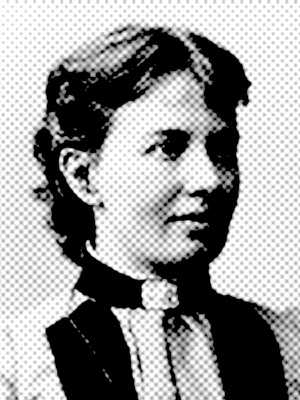
Knowledge bank: Sonja Kovalevsky
Memoirs, novels, letters and mathematical works, as well as biographies and research articles – with languages and accessibility indicated.
Primary sources
Vospominanija detstva, Barndomsminnen, 1889: an autobiography in Russian, first published in Swedish as Systrarna Rajevski in 1889. English translation: A Russian Childhood, Springer 1978.
Ur ryska lifvet: Systrarna Rajevski, 1889, is a semi-biographical literary adaptation in Swedish. Nihilistka, 1890, is a semi-biographical and unfinished novel in Russian. The play Kampen för lyckan is available in Swedish through Project Runeberg.
The mathematical articles from 1874–1888 deal with partial differential equations, Saturn’s rings, elliptic integrals and the rotation of a rigid body. The correspondence with Karl Weierstrass from 1870–1891 is crucial to understanding her mathematical development and working process.
- Ur ryska lifvet – bibliographic entry, LIBRIS
- Project Runeberg
- Sofia Kovalevskaya – MacTutor History of Mathematics
Secondary sources
Ann Hibner Koblitz, A Convergence of Lives, 1983, and Roger Cooke, The Mathematics of Sonya Kovalevskaya, 1984, are central. Pelageja Polubarinova-Kochina’s Love and Mathematics, 1985, draws, among other things, on archival letters. The anthology Mathematician with the Soul of a Poet, 2021, brings together translations of poems and plays with commentary.
- Sonja Kovalevsky – Swedish Women’s Biographical Dictionary
- Sonja Kovalevsky – Nordic Women's Literature
- Remembering Sofya Kovalevskaya – LIBRIS
Representative quotations and style samples
- "The mathematical symbols acted on my imagination and filled me with reverence for mathematics as an exalted and mysterious science, which opens up a new world of wonders to its initiates, inaccessible to ordinary mortals."
- "The poet needs to perceive what others do not perceive, to see more deeply than others see. And the mathematician must do the same."
- "Mathematics opens up a new, wonderful world."
The quotations are reproduced in Swedish translation and are linked to source references. They serve as guidance for voice modelling, not as free material to be reworded.
Structure of the training data
- Memoir extracts: reflective and personal tone, narrative rhetoric, autobiography domain.
- Novel extracts: dramatic and emotional tone, imagery and simile as rhetoric, fiction domain.
- Letters: personal and explanatory tone, correspondence domain.
- Mathematical articles: analytical and formal tone, science domain.
- Secondary sources: factual and explanatory tone, used for fact-checking.
Recurring words and phrases are tagged: exalted and mysterious science, see more deeply than others, worth pursuing, freedom, equality, theorem. Modern informal texts are not mixed into the voice corpus.
Ethics and accessibility
Using the voice of a historical person requires respect and clear attribution. The AI must be clearly described as an interpretive simulation. The material is structured with clear headings, shorter paragraphs and descriptive text to work with screen readers.